Propane glossary
This glossary defines the words you will hear from a propane driver, technician or inspector, from ASME tank and OPD valve to water column, red tag and Keep Full. Each entry starts with the plain meaning, adds the one or two facts that matter at home, and points to a longer guide where we have one.
8
- 80 percent rule
- The 80 percent rule is the practice of leaving headroom in a propane container instead of filling it to the top. Liquid propane swells as it warms, so the empty space lets it expand without forcing the relief valve open. American River Gas fills home tanks to about 86 percent in winter, when the liquid is cold and dense, and to about 80 percent in summer. Learn more →
A
- Aboveground tank
- An aboveground tank sits on a pad or blocks in the yard with its valves under a lid you can open. It is the simplest setup to install, inspect and service. Placement is governed by setback distances from buildings, property lines and ignition sources. Learn more →
- Anode (cathodic protection)
- An anode is a buried metal bag or rod wired to an underground steel tank so that corrosion eats the anode instead of the tank. Together with the tank's coating, this is called cathodic protection. It is part of any properly installed underground steel tank. Learn more →
- Anodeless riser
- An anodeless riser is the factory-made fitting that brings a buried plastic gas line up out of the ground and converts it to metal pipe. Placer County's installation handout allows plastic pipe to end above ground only where one of these risers is used. You will usually see it rising next to the house wall or near the tank. Learn more →
- Appliance connector
- An appliance connector is the short flexible gas line between the fixed piping and a range, dryer or other appliance. The Propane Education & Research Council warns that some older connectors can crack when flexed and says only a qualified professional should install, disconnect or inspect them. If you move an appliance to clean behind it, go slowly and do not twist the line.
- Appliance shut-off valve
- An appliance shut-off valve is a manual valve on the gas line feeding a single appliance, so that one appliance can be isolated without turning off the whole house. Our safety rules call for a shut-off within 6 feet of each appliance. Know where yours are before you need them. Learn more →
- ASME tank
- An ASME tank is a stationary propane storage tank built to the American Society of Mechanical Engineers pressure vessel code, the kind installed at homes, farms and businesses. It is filled in place from a delivery truck and never hauled away to be refilled. Its size, date and working pressure are stamped on a metal data plate. Learn more →
B
- Bobtail
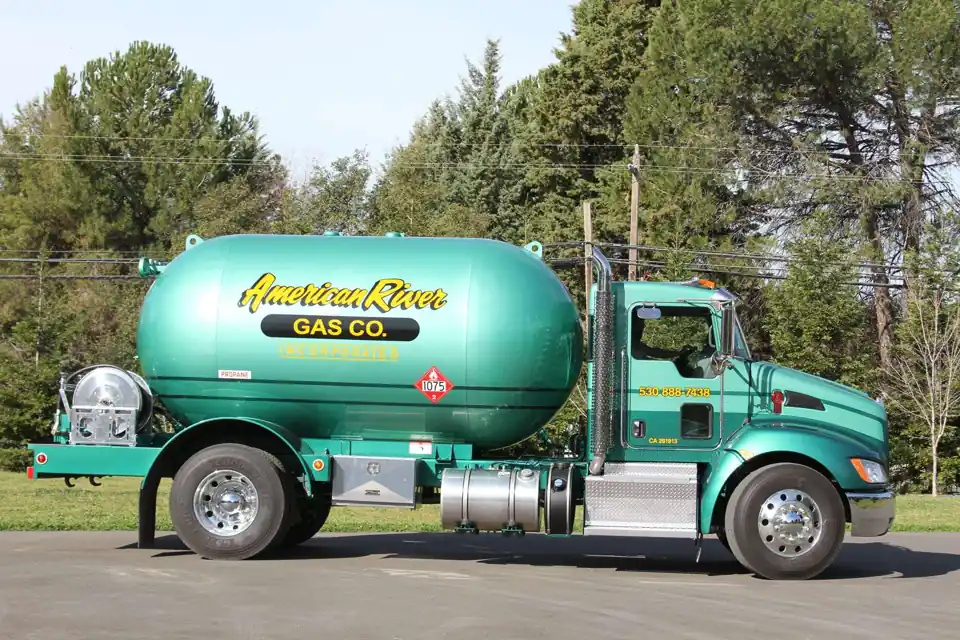
- A bobtail is the straight-body tank truck that delivers propane to homes and businesses. It carries its own meter, pump and hose reel, and American River Gas trucks carry 120 feet of hose, which helps when a tank sits back from the driveway. Keep the path to your tank clear so the driver can pull the hose to it. Learn more →
- British thermal unit (BTU)
- A BTU is a unit of heat, and appliance ratings are given in BTUs per hour. Emerson's LP-Gas handbook lists propane at about 91,500 BTU per gallon, or about 21,500 BTU per pound. Adding up the BTU ratings of your appliances is the first step in sizing a tank or a regulator. Learn more →
- Budget Plan
- The Budget Plan turns an uneven year of propane bills into 11 level payments, followed by one clean-up month that squares the account with actual use. Our plan year runs May to April, with bills going out on the 10th. You need a zero or credit balance to sign up, so ask the office when your account is square.
- Bulk plant
- A bulk plant is a propane company's storage yard, where large tanks hold the supply that delivery trucks draw from. Transports refill the plant, and bobtails load there before their routes. American River Gas's yard is at 10290 Ophir Rd in Newcastle, where we also refill portable cylinders during business hours. Learn more →
C
- Carbon monoxide (CO)
- Carbon monoxide is a colorless, odorless and tasteless poisonous gas produced when fuel does not burn completely. With propane, unsafe levels usually trace back to an appliance that is faulty, poorly maintained or starved of air, or to a blocked vent or chimney. Put a listed CO alarm on every level of the home, and if one sounds or people feel dizzy or sick, get everyone outside and call 911. Learn more →
- Customer-owned tank
- A customer-owned tank belongs to the property owner rather than to a propane company. Owners take on its upkeep and can choose who fills it, as long as the tank remains in safe, serviceable condition. American River Gas fills both leased and customer-owned tanks. Learn more →
- Cylinder exchange
- Cylinder exchange means trading an empty grill cylinder for a filled one at a store rack instead of having yours refilled. Racks from national brands such as Blue Rhino, which is part of Ferrellgas, and AmeriGas are common, and you leave with a cylinder whose date is already current. A refill lets you keep your own cylinder and pay only for the propane put in it. Learn more →
- Cylinder requalification
- Requalification is the federally required inspection or test that keeps a DOT propane cylinder in service. Under 49 CFR 180.209 the first one is due 12 years after the manufacture date on the collar, and later ones follow on a 5, 10 or 12 year cycle depending on the method used. A cylinder that is past due cannot be refilled until it is requalified or replaced. Learn more →
D
- Degree day
- A heating degree day measures how cold a day was: take the day's average temperature and count how far it fell below 65 degrees F. Heating fuel use tracks degree days closely, which is why automatic delivery schedules are built around outdoor temperatures. Our Keep Full timing uses outdoor temperatures together with your past use. Learn more →
- DOT cylinder
- A DOT cylinder is a portable propane container built to U.S. Department of Transportation specifications, such as a grill or RV cylinder. Unlike a stationary tank, it is carried to be filled and must be requalified on a federal schedule. The manufacture date and later requalification marks are stamped on the collar. Learn more →
F
- Fill valve
- The fill valve is the connection on a tank where the delivery driver attaches the hose. Internal check valves let propane flow in but close to stop it flowing back out when the hose comes off. It sits under the dome on most home tanks, and a clear, reachable lid saves time on delivery day.
- First-stage regulator
- The first-stage regulator mounts at the tank and cuts the tank's high, weather-driven pressure down to an intermediate level, usually about 10 psig. That lower pressure travels through the line to the building. A second regulator at the house finishes the job. Learn more →
- Fixed liquid level gauge
- A fixed liquid level gauge is a small bleeder valve connected to a tube that reaches down to the tank's maximum safe fill level. During a fill the driver opens it, and when liquid instead of vapor spits out, the tank is full. Because it vents a little propane, Placer County's handout requires it to sit at least 10 feet from ignition sources such as an A/C compressor or electrical service.
- Flame color
- A healthy flame on a propane range, furnace or water heater burns mostly blue and steady. A burner that turns mostly yellow or orange, lifts off the burner or leaves soot is a sign the gas may not be burning completely, which can raise carbon monoxide. Decorative log sets are the exception, since they are built to make a yellow flame, but any change in how a burner looks deserves a service call. Learn more →
- Flammable range
- Propane can only ignite when it is mixed with air within a narrow band. Emerson's handbook puts that band at roughly 2.15 to 9.6 percent propane in air. Below it the mix is too lean to burn and above it too rich, which is why a leak in a closed room is so dangerous as it builds.
- Float gauge
- The float gauge is the round dial under the tank lid that shows how full the tank is as a percentage of its capacity, not in gallons. A float inside the tank rides on the liquid and turns the needle. To read ours, lift the dome 6 to 8 inches and let it drop, then read the 0 to 100 dial, where the top of the red band is about 20 percent. Learn more →
G
- Gallon
- Propane is sold by the liquid gallon at the tank. Emerson's handbook puts a gallon at about 4.2 pounds at 60 degrees F, and it expands into about 36 cubic feet of vapor. Your delivery ticket shows gallons as measured by the meter on the truck. Learn more →
- Gas detector
- A propane gas detector is an alarm that senses propane in the air and can catch a leak you cannot smell. PERC recommends one, installed and cared for according to the maker's instructions. It is a different device from a smoke alarm or a CO alarm, though combination units exist.
- Gas line
- The gas line is all the pipe that moves propane vapor from tank to house and on to each appliance. Buried sections are usually plastic rated for gas or steel with a factory coating, and Placer County's handout sets minimum cover at 12 inches, deepening to 18 where outside forces could harm the pipe. Before digging near one, call 811 to have it marked. Learn more →
- Gas meter
- Most home propane accounts are billed for the gallons delivered, as measured by the meter on the truck, so the house itself has no meter. Where several homes or units share one tank, each may have a vapor meter so use can be split fairly. Keep snow and ice off any meter, regulator or piping you have.
H
- Heavier than air
- Propane vapor is about one and a half times as heavy as air, according to Emerson's handbook. A leak therefore tends to settle and pool in low places such as basements, crawl spaces and ditches instead of drifting away. That is one reason you might not smell a leak right away.
I
- Integral twin-stage regulator
- An integral twin-stage regulator, also called an integral two-stage regulator, combines a first stage and a second stage in one body mounted at the tank. It is common where the tank sits close to the house. Emerson's handbook notes that NFPA 58 accepts it in place of separate regulators on fixed piping systems. Learn more →
K
- Keep Full
- Keep Full is our automatic delivery program, where we plan each fill around the weather and how much you have used before, so the gauge is our job instead of yours. Should a Keep Full account in good standing still run dry, the special trip and leak test carry no charge, with some restrictions. It suits homes that heat with propane and would rather not watch the gauge. Learn more →
L
- Leak check
- A leak check, sometimes called a pressure check or leak test, confirms the whole gas system holds pressure before propane is turned on. We require one for new installations, new customers, repairs, modifications or shut-offs, suspected leaks, new appliances, and any time a tank has run out. After a run-out, safety codes and our insurance require the check, someone must be home, and there is an extra charge. Learn more →
- Leased tank
- A leased tank is owned by the propane company and set on your property for your use. The company generally handles its maintenance and fills it. Whether to lease or own depends on your tank size, how long you plan to stay and your budget. Learn more →
- LP-gas
- LP-gas, short for liquefied petroleum gas, is the family of fuels that includes propane and butane. They are stored as a liquid under modest pressure and burned as a vapor. Around the home, LP-gas almost always means propane.
M
- Mercaptan (odorant)
- Mercaptan is the strong-smelling chemical, usually ethyl mercaptan, added to propane so that a leak can be noticed. Pure propane has almost no smell, and many people describe the added odor as rotten eggs or a skunk. If you smell it, leave the building first, then call 911 and us from outside.
N
- NFPA 54
- NFPA 54 is the National Fuel Gas Code, published by the National Fire Protection Association. It covers gas piping, appliance installation and venting inside and around buildings. Your technician works to it when adding an appliance or running a new line.
- NFPA 58
- NFPA 58 is the Liquefied Petroleum Gas Code, the national standard for storing and handling propane. It governs tanks, cylinders, valves, regulators, setbacks and delivery. State and local codes build on it, so it is the rulebook behind most of the terms on this page.
- NPGA
- The National Propane Gas Association is the national trade association for the U.S. propane industry. It represents retailers, producers and equipment makers and supports safety training. It is separate from PERC, which runs the industry's education and research program.
O
- Odor fade
- Odor fade, also called odor loss, is when the added odorant weakens so a leak is harder to smell. PERC notes that soil, water and rust can absorb the odorant, which matters most in new tanks and lines. Because of this, and because a nose can tire of a smell it has been around for a while, a gas detector is good backup to your nose.
- OPD valve
- An OPD, or overfilling prevention device, is a valve feature that automatically stops a fill before a small cylinder is too full. PERC describes it as required by law and says most OPD valves have a triangular handwheel marked OPD. A cylinder without one should be exchanged or replaced, not refilled. Learn more →
- Outage
- In propane terms, outage is the vapor space left at the top of a container above the liquid. It exists on purpose, so the liquid has room to expand as it warms. Filling to the correct level preserves the outage.
P
- PERC
- The Propane Education & Research Council is the industry program created by Congress under the Propane Education and Research Act of 1996. It publishes consumer safety guidance at propane.com and funds training and research. Many of the safety points on this site come from its materials.
- Pilot light
- A pilot light is a small, steady flame that some appliances use to light the main burner. Pilots go out when the gas runs out or is shut off, or when an appliance or venting problem develops. After a run-out, leave the pilots alone until the system has had its leak check. Learn more →
- POL valve
- POL is an older style of cylinder connection with a reverse, left-hand thread that screws into the valve outlet. It still appears on many larger cylinders and on older grill tanks and equipment. Newer grill cylinders usually use the larger, hand-tightened Type 1 fitting instead. Learn more →
- Pound
- Small cylinders are sized by the pounds of propane they hold, so a 20-pound grill cylinder holds about 20 pounds. At about 4.2 pounds per gallon, that works out to a little under 5 gallons. Larger RV cylinders follow the same naming. Learn more →
- Pressure test
- A pressure test holds new or altered gas piping at a set pressure to prove it is tight before it is put into service. Placer County's handout calls for at least 10 psi for 15 minutes on typical piping, and at least 60 psi for 30 minutes on piping that will carry more than 14 inches of water column. It is separate from, and comes before, the leak check done when gas is turned on. Learn more →
- Psig
- Psig means pounds per square inch gauge, a pressure reading above normal air pressure. Tank pressure is measured in psig and rises and falls with temperature. Appliance pressure is so much lower that it is measured in inches of water column instead. Learn more →
R
- Red tag
- A red tag is the warning label a technician hangs on a gas system or appliance that fails a safety check or falls short of code. Gas stays off to that equipment until a qualified technician fixes the problem. Leave the tag in place and do not try to restore gas on your own. Learn more →
- Regulator
- A regulator is a spring-and-diaphragm valve that drops the tank's high pressure to the low, steady pressure appliances need. Most homes use two, one at the tank and one at the building. Regulators wear with age and weather and are replaced on the manufacturer's schedule. Learn more →
- Regulator vent
- The regulator vent is the small screened opening a regulator breathes through. If ice, mud, insects or paint plug it, the regulator cannot control pressure. Keep it pointed down or under a cover, and never paint over it. Learn more →
- Relief valve
- The pressure relief valve is a spring-loaded valve on every tank and cylinder that opens to release vapor if pressure climbs too high, for example on a very hot day or in a fire, then closes again. It protects the container from rupture. Never plug it, cap it or stand over it when it is venting.
- Route day
- Your route day is the day of the week our delivery trucks work your neighborhood. Orders you call in normally arrive within about a week, on that day. The office can tell you which day covers your address. Learn more →
S
- Second-stage regulator
- The second-stage regulator mounts at the building and brings line pressure down to about 11 inches of water column, the level most home appliances are built for. Splitting the reduction between two regulators keeps appliance pressure steadier. It also cuts down on regulator freeze-ups. Learn more →
- Sediment trap
- A sediment trap, or drip leg, is a short capped pipe below an appliance's gas connection that catches dirt and moisture before they reach the controls. Gas codes call for one ahead of most appliances, with some listed exceptions. Your installer adds it when an appliance is connected.
- Service valve
- The service valve is the main shut-off on top of the tank, under the lid. PERC's leak steps say to close it by turning it to the right, clockwise, when it is safe to reach and the leak does not seem to be at the tank itself. After it has been closed, a professional must check the system before gas is turned back on. Learn more →
- Setback
- A setback is the required clearance between a propane tank and nearby buildings, property lines or sources of ignition. According to Placer County's handout, a tank of 125 gallons or less needs 5 feet, one of 126 to 500 gallons needs 10 feet, and one of 501 to 2,000 gallons needs 25 feet, while the filling connection must be 10 feet from ignition sources. Sites above 5,000 feet follow rules set by the local fire district. Learn more →
- Single-stage regulator
- A single-stage regulator drops tank pressure to appliance pressure in one step. NFPA 58 has not allowed a new one on a home's fixed piping system since 1997, and they are most often found on older installations. If you have one, ask about upgrading to two-stage regulation. Learn more →
T
- Therm
- A therm is 100,000 BTU, the unit natural gas utilities use on their bills. At about 91,500 BTU per gallon, roughly 1.1 gallons of propane equals one therm. That conversion lets you compare a propane bill with a natural gas quote on equal terms. Learn more →
- Title 8 LP-gas rules
- Title 8 of the California Code of Regulations holds the state's workplace safety orders, and Article 5 of its Unfired Pressure Vessel Safety Orders covers LP-gas systems. Cal/OSHA enforces these rules for propane containers and equipment in California. They sit alongside NFPA 58 and local fire and building codes.
- Tracer wire
- A tracer wire is a copper wire buried along a plastic gas line so the line can be located later from above ground. Placer County's handout requires one, at least 14 AWG, for the full length of underground plastic piping, with one end brought above ground. It is how a locator finds the pipe when you call 811. Learn more →
- Transport
- A transport is the large tractor-trailer tanker that hauls propane from terminals and rail yards to a company's bulk plant. It is much bigger than a bobtail and does not make home deliveries. Transport supply and freight are part of what drives the local price of propane. Learn more →
- Two-stage regulation
- Two-stage regulation uses a first-stage regulator at the tank and a second-stage regulator at the building to reduce pressure in two steps. Emerson's handbook says NFPA 58 requires either this setup or an integral two-stage regulator on fixed piping systems serving appliances at 11 inches of water column. It keeps pressure steadier and limits how high pressure can climb if a regulator fails. Learn more →
- Type 1 connection
- The Type 1 connection is the large, hand-tightened threaded fitting found on most modern grill cylinder valves and hoses. It replaced the wrench-tightened POL fitting for most grill use. Tighten it by hand only and check it with soapy water each time you connect a cylinder. Learn more →
U
- Underground tank
- An underground tank is an ASME tank buried in the yard with only its lid and valves showing at grade. It frees up yard space and is protected from corrosion with a coating and anodes. Placer County's handout notes that underground tanks are inspected and approved by the local fire district before building final. Learn more →
V
- Vaporization
- Vaporization is the tank turning liquid propane into the vapor your appliances burn, using heat drawn from the tank's steel shell. Emerson's handbook explains the rate falls as the liquid gets colder and as less of the tank wall is wetted by liquid. A low tank on a cold night can struggle to keep up with heavy use, which is one reason to reorder around 30 percent. Learn more →
- Vent-free appliance
- A vent-free, or unvented, appliance burns gas inside the room and releases its exhaust into the room rather than up a flue. California Health and Safety Code section 19881 bars selling new or used unvented heaters designed for use inside a home, apart from electric heaters and decorative gas logs for a vented fireplace. Talk to us before buying any propane heater meant for indoors. Learn more →
W
- Water capacity
- Water capacity is how tank sizes are stated: a 500-gallon tank holds 500 gallons of water. Because propane needs room to expand, the same tank holds noticeably less propane, around 400 gallons at an 80 percent fill. Keep this in mind when you compare tank sizes or estimate how long a fill will last. Learn more →
- Water column (WC inches)
- Inches of water column is a unit for very low gas pressure, based on how high the pressure could push a column of water. Emerson's handbook puts 1 psi at about 27.7 inches, so the 11 inches most home appliances run on is about four-tenths of one psi. Technicians check it with a manometer when setting up or troubleshooting appliances. Learn more →
Sources: NFPA 58: Liquefied Petroleum Gas Code (National Fire Protection Association) (opens in a new tab) · Emerson Fisher LP-Gas Serviceman's Handbook (LP-10) (opens in a new tab) · Propane Education & Research Council: Safety Guide for Propane Users (opens in a new tab) · Placer County Building Services: Liquid Propane Gas Tank Installation Below 5,000 Feet (opens in a new tab) · California Health and Safety Code section 19881 (unvented heaters) (opens in a new tab)
Newcastle yard · since 1966
Questions about propane?
Call the office and talk to a real person. Or leave your details and we call you back.
Monday-Friday 8:00 AM-4:30 PM (closed noon-1:00 PM)
After hours, weekends and holidays, our answering service reaches a staff member.